12. Rights Of The Deceased
We should know that when a person observes signs of death in himself, he should pay attention to his own condition, because he is about to undertake the journey of the hereafter, so he should be equipped for it.
First of all, it is necessary for him to confess to his sins, complete recantation for the future and seeking divine forgiveness. So that God may not leave him to his devices in the circumstances, which are to befall him in the future.
After that he should draw up his will and fulfil all the rights of God and people, which are obligatory on him. He should not leave it for his successors, because once a person is dead, he had no control over his property and after he is dead, Satans instigate the successors not to fulfil the rights upon the deceased. He implores to be taken back only for a little while, so that he may do from his funds what he wants. But it is of no use.
Then he should make a will for one-third of his property, for charities and whatever else he likes. Then he should ask his brothers in faith to condone his faults. For example, if he has backbitten, insulted or harassed someone, and they are present, he should seek their forgiveness. If they are not present, he should ask other believers to get them to forgive his faults
After that he should entrust his dependants to a trustworthy person. He should appoint a trustee for his young children. Then he should ask for his shroud and get written on them with dust of the grave of Imam Husayn (‘a) the dual testimonies of faith, the true beliefs and supplications, which are mentioned in details. It is when he had not prepared his shroud from before. Whereas the believer should have his shroud ready all the time.
Thus, it is narrated from Imam Ja’far As-Sadiq (‘a) that one, who has a shroud ready from before, he will not be written among the negligent; and whenever he looks at it, he will get divine rewards.
After calling for the shroud, he should stop thinking about wealth and family and focus his attention on Almighty Allah. He should remember Him alone, and he should realize that these temporal things are of no use to him and nothing is going to help him, except divine mercy.
When I have been righteous, the affairs of the survivors will be automatically taken care of. Even if I remain alive, without the will of Allah, no one can cause any profit or loss to them. It is true that God is their creator and He is most kind to them.
Then he should adopt the attitude of being between fear and hope. He should hope most for the arrival of the Messenger of Allah (S) and the Holy Imams (‘a), because they arrive at such time, give glad tidings to their Shi’a and recommend their case to the angel of death.
It is narrated through authentic chains of narrators from the Messenger of Allah (S) that one, who does not make a good will at the time of death, his intellect will be considered defective. People asked: O Messenger of Allah (S), how should we draw a will? When it is the time of death and people gather around him, he should say:








Translation: O Allah, the originator of the heavens and the earth. Knower of the unseen and its seer. The beneficent and the merciful. Indeed! I promise to You. Indeed! I testify that there is no god, except You. You are one without partner. And that Muhammad, may Allah bless him and his progeny, is Your slave and Your Messenger and indeed the Hour will arrive, there is no doubt in it.
And indeed! You raise those in the graves and that the accounting is truth and that the Paradise is fact and what Allah promised in it from the blessings of foods and drinks and marriage are all true.
And that the Hell is a fact and faith is truth as You described and that Islam is like You legislated and the statement as You stated and that the Qur’an as You revealed and that You are Allah the truth manifest and indeed I promise You in the abode of the world that I am pleased with You as a Lord and by Islam as religion and by Muhammad as Prophet (peace be on him and his progeny and blessings) and by Ali as the Imam and by Allah as the Book and that Ahl Al-Bayt of Your Prophet (peace be on them all) are my Imams.
O Allah, You are my trust in distress and my hope in difficulty and my refuge in every matter that befall me and You are my guardian in my bounty and my God and the god of my forefathers, may Allah bless Muhammad and his progeny and do not leave me to my devices even for the blink of the eye and give companionship to my loneliness in the grave and make my covenant open with You on the day of meeting You.
After that the Messenger of Allah (S) said: When the dying person wants to make a bequest his promise to the Almighty Allah is as mentioned above; and making a bequest is obligatory on all Muslims.
Imam Ja’far As-Sadiq (‘a) said: The testimony of this statement is mentioned in Surah Maryam as well, where the Almighty Allah says:

“They shall not control intercession, save he who has made a covenant with the Beneficent God.” (19:87).
The oath mentioned in the verse is this only.
The Messenger of Allah (S) said to Amir Al-Mu’minin (‘a): Jibra’il taught me the above-mentioned will. You memorize it and teach it to your Ahl Al-Bayt (‘a) and Shi’a.
After the bequest, if you have not prepared your scroll from before, you should summon some believers and make them testify for your beliefs. And mention the beliefs as follows:


Translation: In the name of Allah, the Beneficent, the Merciful. I testify that there is no god, except Allah. He is one, there is no partner for him. And that Muhammad is His slave and His Messenger. May Allah bless him and his progeny. And that Paradise is a fact and that the Hell is a fact and that the Hour will arrive without any doubt in it. And that Allah will raise those, who are in the graves.
Then the following should be written on a piece of cloth or paper:










Translation: In the name of Allah, the Beneficent, the Merciful. The names of the witnesses mentioned in this document all of them testify that our brother in faith, so and so son of so and so (write the name of the deceased and his father here - then continue) made us witness and regarded us as the safe keeper of his statement and confessed to us in our presence that there is no god, except Allah.
The one, who has no partner. And that Muhammad (may Allah bless him and his progeny) is His servant and His messenger. And that He made all the prophets and messengers confess to it (peace be on them all).
And that Ali is the Wali of Allah and His Imam and that the Imams from his progeny are His Imams and that the first of them is Hasan and Husayn and Ali Ibn Al-Husayn and Muhammad Ibn Ali and Ja’far Ibn Muhammad and Musa Ibn Ja’far and Ali Ibn Musa and Muhammad Ibn Ali and Ali Ibn Muhammad and Hasan Ibn Ali and the Qaim Hujjat, peace be on them.
And that the Paradise is truth and the Hell is truth and that the Judgment Day will indeed arrive, without any doubt and that Allah will raise those, who are in the graves and that Muhammad, may Allah bless him and his progeny, came with the truth. And that Ali is the Wali of Allah and His caliph after the Messenger of Allah, may Allah bless him and his progeny.
And he left him in his Ummah as the fulfiller of the command of Allah, the blessed and the high. And that Fatimah, the daughter of the Messenger of Allah, may Allah bless him and his progeny, and her sons, Hasan and Husayn, the two sons of the Messenger of Allah, may Allah bless him and his progeny, and his two grandsons and the Imams of guidance and the leaders of mercy.
And that Ali and Muhammad and Ja’far and Musa and Ali and Muhammad and Ali and Hasan and the Hujjat, peace be on them all, are the Imams and leaders and the callers to Allah, the Mighty and Sublime and His proofs on His servants.
Names of the witnesses should be mentioned under the will. Then he should call them by names and say:

Translation: Remember firm on your testimony till the time we meet at the Cistern of Kauthar.
Then the witnesses should tell him:

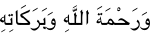
Translation: We entrust you to Allah and we promise that our testimony, your confession and our being brothers in faith be mentioned before the Messenger of Allah (S) and convey to him salutations and the peace and mercy of Allah.
Then that scroll should be rolled up and sealed by the person and the witnesses and at the time of burial, it should be kept on the right side of the deceased.
It is narrated that the Messenger of Allah (S) went to a man from Ansar, when he was in the throes of death and asked about his condition. He replied: I am hopeful of divine mercy and afraid of my sins. He said: Almighty Allah will definitely fulfil the wishes of one having such condition at the time of death.
It is mentioned in another tradition that the Messenger of Allah (S) went to see a person when he was in his last moments and told him to recite:

Translation: O Allah, forgive me the excess of Your disobedience and accept from me the least of Your obedience.
As for the matter related to the survivors and friends of the dying person, they should not leave him alone. They should recite the Holy Qur’an, supplications, Surah Yasin and Surah Saffat and repeatedly teach him the oneness of God, prophethood of the Messenger of Allah (S), Imamate of the Holy Imams (‘a) and other beliefs - that Hell and Paradise are facts, that Allah is having the most perfect qualities and free from defective traits. If is unable to recite, they should recite for him.
They should also recite Dua Adilah. If he does not understand Arabic, they should inform him of the meaning. They should turn his feet to the Qibla. Persons, who are in menses or in condition of sexual impurity should not come near him as angels dislike this. If anyone else is not present, they are allowed to stay near the dying person. But they should move away at the final moment.
It is mentioned in reliable traditions that if a person is having a difficult death, he should be taken to a place, where he used to pray or he should be laid on the prayer mat, so that if he is to recover, he will do so or he will die in peace.
It is mentioned in reliable tradition that the Messenger of Allah (S) went to visit a person from the descendants of Abdul Muttalib when he was in his throes of death. He ordered them to turn his feet to Qibla, so that angels may approach him and the divine mercy may descend on him.
It is narrated from Imam Ali Ar-Ridha’ (‘a) that you should never touch the dying person when he is in the throes of death and if he flays his limbs, you should not stop it as the ignorant do. On the contrary, recite the Holy Qur’an, recitations and invoke blessings on Muhammad and Aali Muhammad (‘a).
It is narrated in another tradition that a son of Imam Ja’far As-Sadiq (‘a) was in the throes of death and Imam Muhammad Al-Baqir (‘a) was seated in the comer of the room. If anyone approached the dying person, he told him not to touch him as he was very weak in that condition and touching him was like killing him.
In reliable tradition, it is narrated from the Messenger of Allah (S) that you should ask the dying person to recite:

Translation: There is no god, except Allah.
Because, one, whose last words are these, will enter Paradise.
He said in another tradition that you recite to them:

Translation: There is no god, except Allah.
As it removes the sins.
It is narrated from Imam Muhammad Al-Baqir (‘a) in an authentic tradition that when you find anyone in the throes of death, you should make him recite the following words of relief (Faraj)


Translation: There is no god except Allah, The Forbearing, the Noble. There is no god except Allah, the Exalted and the Mighty. Glory be to Allah, the Lord of the seven heavens and the Lord of the seven earths. And what is in them and what is between them. And the Lord of the great power. And praise be to Allah, the Lord of the worlds.
It is mentioned in another tradition that if someone was in the throes of death in the house of Amir Al- Mu’minin (‘a), he made him recite the words of relief (Faraj) and when he concluded, he used to say: Now, there is no fear for you.
It is mentioned in a good tradition that the Messenger of Allah (S) went to see a man from Bani Hashim during the throes of his death and commanded him to recite the words of relief (Faraj) When he concluded, he said: Praise be to Allah, Allah has saved him from hellfire.
It is narrated from Imam Ja’far As-Sadiq (‘a) in another authentic tradition that Satan appoints with every person a group of Satans so that they may continue to cast doubts about religion at the time of his death. If the dying person is a perfect believer, they cannot cast doubts on him.
But others are not free from hardships. Therefore, as long as a person can speak, he should be made to recite the words of relief (Faraj), the dual testimony of faith and confession to the Imamate of the Holy Imams (‘a), one after another.
He said in another authentic tradition that even if an idol-worshipper sincerely confesses to the belief of Shi’a and the Holy Imams (‘a), the hellfire will not touch him at all.
He said in another tradition that a person was about to die. The Messenger of Allah (S) went to see him with some companions. He was unconscious at that time. He said: O angel of death, wait for a moment, I want to ask him something.
That man regained his consciousness. The Holy Prophet (S) asked: What do you see? He replied: Excess of whiteness and darkness. He said: Which is closest to you? He replied: Darkness. He said: Recite:

Translation: O Allah, forgive me the excess of Your disobedience and accept from me the least of Your obedience.
Then that person lost consciousness again. Then he told the angel of death to give him some respite. Then he regained his senses. Again, the Messenger of Allah (S) asked: What can you see now? He replied: Excess of whiteness and darkness. He said: Which is the closest? He replied: Whiteness. He said: This man has got salvation.
After narrating this tradition, Imam Ja’far As-Sadiq (‘a) said: If you reach a person at this time, you should make him recite this supplication only.
It is mentioned in another tradition that a young man was on his deathbed when the Holy Prophet s) came, sat near him, and told him to recite two testimonies of faith (Shahadatain). But the youth could not
speak. The Holy Prophet (S) inquired if his mother was present? A woman sitting near his head said, “Yes, I am his mother.”
The Holy Prophet (S) asked, “Are you displeased with him?” ‘Yes, O Prophet (S), we have not spoken to each other since the past six years.’
The Holy Prophet (S) asked this woman to forgive her son. She forgave him. At once the young man was able to recite the Kalimah. The Holy Prophet (S) asked, “What do you see now.” “O Prophet of Allah, a dark and smelly man is holding me and is not leaving.” The Holy Prophet (S) told him to recite the following supplication:

Translation: O one, Who accepts the easiest and forgives much. Accept the easiest and forgive me the excess. Indeed You are the forgiving and merciful.
He recited it. Then Prophet asked, “Now, what do you see?” He replied, “A fair, handsome and fragrant man is moving towards me.” The Prophet said, “Keep repeating this supplication.” When the youth repeated, he said “O Prophet of Allah (S) both have disappeared from my sight.” After this the face of the Holy Prophet (S) was illuminated with joy. He said, “O Allah forgive the sins of this young man.” Then the youth passed away.
When a believer passes away, it is recommended to close his eyes and mouth and to tie a strip of cloth from below the chin to the head and straighten his hands and cover him with a cloth. The Holy Qur’an should be recited besides him and haste should be made in his funeral.
It is narrated from Imam Ja’far As-Sadiq (‘a) that the faithful should be informed of his death, so that they may attend his funeral prayer and supplicate for his deliverance; so that they as well as the deceased are rewarded.
It is narrated from Imam Ja’far As-Sadiq (‘a) in a good tradition that when people place the believer in his grave, he is told: The first gift that We give you is Paradise and the first reward We give to those, who attended your funeral is that they are forgiven.
He said in another tradition that the first gift, which a believer receives in grave is that all who participated in his funeral are forgiven.
He said in another tradition that one, who remains with a deceased believer till he is buried, on Judgment Day, Almighty Allah will appoint seventy angels for him to accompany him from the grave till the place of accounting and they will continue to seek forgiveness for him.
He also said that twenty-five sins are forgiven of a person, who supports the bier on one comer. If he
supports from all four comers, all his sins are forgiven. And the best method is to firstly take the left upper end of the deceased on the right shoulder; then give the right shoulder to the lower comer; then lift the lower end of the bier on the left shoulder, then lift the left shoulder of the deceased on the left side. This method is known as Tarbee.
If one wants to repeat it, one should not cross the bier from the front, but from behind and repeat the procedure. It is better that one should follow the bier or walk at the side and not to walk in front of it.
The apparent meaning of these traditions is that if it is the bier of a believer, it is better to walk in front of it; but it is not advisable to walk before the bier of a person from opponents, because angels of chastisement come to ‘welcome’ him. It is detestable to ride with the corpse.
It is narrated from the Messenger of Allah (S) that one, who recites the following supplication on seeing a bier, no angel remains in the heavens, which does not weep at his forlorn call:

Allah is the greatest.

This is what Allah and His Messenger promised. And Allah and His Messenger said the truth. (33:22)

Translation: O Allah. Increase faith and submission for us. Praise be to Allah, Who is dominant by His power and Who subdues the servants by death.
It is narrated from the Messenger of Allah (S) that one, who accompanies a bier, for each step of his, a hundred thousand good deeds will be written for him, a hundred thousand sins will be erased from the scroll of his deeds and a hundred thousand ranks will be elevated for him in Paradise.
And if he prays on that deceased; after his death, Almighty Allah will send a hundred thousand angels to pray on his bier, who will continue to seek forgiveness for him till he is buried and if he remains present till the burial, Allah appoint the same hundred thousand angels to seek forgiveness for him till Judgment Day and till he emerges from the grave.
It is narrated from Imam Muhammad Al-Baqir (‘a) in a reliable tradition that a believer, who gives the
funeral bath to a believer, and who recites the following supplication at the time of turning him from one side to another, his sins of one year will be forgiven, but they do not include the major sins:

Translation: O Allah, indeed this is a body of Your believer slave and indeed You removed his soul from him and separated the two of them. Please be merciful, merciful.
He said in another tradition that one, who gives the funeral bath to a deceased and does not divulge any of the defects he notices in the body, all his sins will be forgiven.
He said in another tradition that Prophet Musa (‘a) inquired from his Lord about the reward of a person, who gave a funeral bath of the deceased. He was told: I purify him from sins as if he is just bom.
In a good tradition, it is narrated from Imam Ja’far As-Sadiq (‘a) that one, who gives the funeral bath to a believer, and at the time of giving the funeral bath, he repeatedly says:

Translation: Lord, please be merciful, merciful.
The Almighty Allah forgives him as well.
It is mentioned in Fiqhat Ar-Ridha’ (‘a) that the person bathing the dead should recite the following supplication at the time of passing the hand over the belly:

Translation: O Allah, indeed I have filled the belly of this deceased with love of Muhammad and his progeny, now You be merciful on him.
In reliable tradition, it is narrated from Imam Muhammad Al-Baqir (‘a) that one, who gives shroud to a believer, he will be rewarded so much as if he had taken the responsibility to clothe him till Judgment Day. One, who digs a grave for a believer, he will be rewarded so much, as if he had given a nice house for the believer to live till Judgment Day.
It is narrated from the Messenger of Allah (S) that one, who prays on one bier, seventy thousand angels will pray on his bier; and all his previous sins would be forgiven. Then if he remains there till the burial, he will get one karat reward and each karat will be equal to Mt. Uhad.
He said in another tradition that Paradise becomes obligatory on a person who prays on the bier of a believer, except if he becomes a hypocrite after that or he is disowned by the parents.
Through reliable chains of narrators, it is narrated from Imam Ja’far As-Sadiq (‘a) that when a believer dies, and forty believers attend his funeral and say:

Translation: O Allah, indeed we know of good from him and You are more knowing about it than us.
The Almighty Allah says: I have accepted your testimony and forgiven all his sins, which 1 know and you are unaware of.
It is narrated from the Messenger of Allah (S) in another reliable tradition that after the death of a believer it is mentioned in title of his scroll of deeds, what people say regarding him - righteous or unrighteous.
In a good tradition, it is narrated from Imam Ja’far As-Sadiq (‘a) that the corpse should be lowered into the grave from the feet side. And when it is placed in the grave, recite the following after Ayat ul-Kursi:


Translation: In the name of Allah and in the path of Allah and upon the religion of the Messenger of Allah. O Allah, open in this grave a window to Paradise and join him with the Messenger of Allah (S). O Allah, if he is righteous, increase his good deeds and if he is bad, forgive his sins. Have mercy on him and overlook his mistakes.
And pray for his forgiveness in excess.
When Imam Zayn Al-’Abidin (‘a) used to lower a corpse into the grave, he used to recite the following supplication:

Translation: O Allah, expand the earth from his sides. Accept his scroll of deeds and be pleased with him.
He said in another tradition that when the corpse is placed in the grave, it is necessary that the persons senior to him should be at his head. They should be intoning the name of God. They should be invoking
blessings on Muhammad and progeny of Muhammad, seeking refuge from the evil of Satan, and they should be reciting Surah al-Hamd, Surah al-Falaq, Surah an-Nas, Surah at-Tawhid and Ayat ul-Kursi.
After placing the corpse in the grave, if it is possible, the cheek should be touched to the ground. At that time the dual confession of Islam and confession of belief in the Imams and other true beliefs should be reminded.
He said in another tradition that the following should be recited when the grave is being filled up:

Translation: O Allah, we have faith in You and testimony is given that You will raise the dead on Judgment Day.

This is what Allah and His Messenger promised. (33:22)
Instead of each particle of that soil, a reward will be written in their scroll of deeds. When people return after making the grave, the closest relative of the deceased should sit at the head of the grave and recite the Talqeen. As because of this the Munkir and Nakeer do not question him.
It is emphatically recommended that the survivors of the deceased should be given condolence after the burial near the grave only. It is also recommended to give condolence to the relatives of the deceased before the burial as well,
It is narrated from the Messenger of Allah (S) that one, who gives condolence to an aggrieved person, on Judgment Day he will be given a robe of Paradise and he will get as much reward as the person affected by the tragedy without there being any decrease in the reward of that person.
It is mentioned in many reliable traditions that one, who recites Surah al-Qadr seven times upon the grave of a believer brother, Almighty Allah will appoint an angel on his grave to worship God and the reward of that worship will be recorded for that person. And when he will be raised from his grave, till he reaches Paradise, he will be protected by that angel from all the terrors of Qiyamat.
The Messenger of Allah (S) said: One, who passes a cemetery, should recite Surah at-Tawhid eleven times and gift the reward to those buried there; he will get the same amount of reward as those, who are buried there will get.
[1] [1]
SHARES