1. Etiquette Of Greeting And Its Reply
It is mentioned that the Messenger of Allah (S) ordered his companions to adopt seven excellent moral qualities: (1) to visit the sick (2) to attend funerals (3) to believe anyone, who swears (4) to bless one, who sneezes (5) to help the oppressed (6) to greet everyone (7) to accept invitations.
In another reliable tradition, it is narrated from the Messenger of Allah (S) that there are some houses in Paradise from which all outside conditions are visible and inside from outside. Those from my Ummah will get to live in these houses, who interacted with others cordially, who feed them, who greet aloud and who pray at night when all are asleep.
After that he said: To greet aloud implies that you must not be miserly in greeting any Muslim.
It is narrated from Imam Ja’far As-Sadiq (‘a) that humility includes greeting anyone, who happens to come before us.
It is narrated from the Messenger of Allah (S) that you must not reply to one, who begins speaking without greeting; and you must not even offer him to eat anything.
He said in another tradition that the most helpless is one, who is helpless in supplicating. And the most parsimonious is one, who is parsimonious in greeting.
He said in another tradition that one, who meets and greets ten people while walking here and there, the reward of emancipating a slave will be recorded for him.
It is narrated from Imam Ja’far As-Sadiq (‘a) that angels respond to the greeting of the believer, who greets a group of believers.

Translation: Peace be on you and the mercy of Allah and His blessings forever.
It is narrated from the Messenger of Allah (S) that greeting is recommended and responding to it is
obligatory.
It is narrated from Imam Ja’far As-Sadiq (‘a) that when someone greets, he should do so in a loud voice, so that all hear it, so that he cannot claim that he greeted and no one replied. In the same way, the greeting should also be responded aloud, so that the person who has greeted may not be able to say that he greeted, but no one responded.
He said in another tradition that one, who says:

Translation: Peace be on you (all).
Ten rewards are given to him. And one, who says:

Translation: Peace be on you, and the mercy and blessings of Allah.
Thirty rewards are given to him.
He said in another tradition that there are three persons, such that even if they are alone, the plural verb should be used for them...one, who sneezes, he should be told:

Translation: May Allah have mercy on you (all).
Though there might be no one with him.
Secondly, one, who is greeted: he should be told:
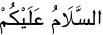
Translation: Peace be on you (all).
Or:

Translation: Peace be on you (all).
Though he might be alone.
Thirdly, the one, who is blessed, should be said:

Translation: May Allah forgive you (all).
Though he might be alone. Its reason is that angels are present with him. Also, the believers not present there can be included among the blessings.
It is narrated from Amir Al-Mu’minin (‘a) that it is detestable to bless someone by saying:

Translation: May Allah keep you alive.
If you want to say this, you should state:

Translation: May Allah keep you alive with health.
It is narrated from Imam Ja’far As-Sadiq (‘a) that you should never greet three kinds of people: (1) one, who is accompanying a corpse (2) one, who is going for Friday prayer (3) one, who is in the bathroom, and there is chance that he does not have cloth around his waist.
It is narrated from Imam Muhammad Al-Baqir (‘a) that when you reach the Masjid and people are praying, you should not greet them. On the contrary, you should greet addressing the Messenger of Allah (S) and join the prayer. And if you reach a gathering, where people are speaking, you can greet them.
It is narrated from Amir Al-Mu’minin (‘a) that one, who enters his house, he should greet his family members and if no one is present, he should say:

Translation: Peace be upon us from our Lord.
He also said that if someone says to you:

Translation: May Allah keep you alive with health.
You should reply:

Translation: May Allah keep you also alive with health and convey you to Paradise.
It is narrated from the Messenger of Allah (S) that when you meet each other, you should greet and shake hands with each other and when you disperse, you should seek forgiveness for one another.
He said in another tradition that one, who comes home and greets his family members, that house will be blessed and angels will become fond of that place.
It is narrated from Imam Ja’far As-Sadiq (‘a) that if a lady comes across some people, she must address them and say:
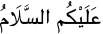
Translation: Peace be on you (all).
And if a man comes across some people, he should address the people of the gathering and say:
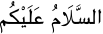
Translation: May peace be on you (all).
Or

Translation: Peace be on you (all).
It is mentioned in some traditions that there are some people, who should not be greeted: (1) Jews (2) fire-worshippers (3) Christians (4) idol-worshippers (5) one, who is in the washroom (6) one, who is apparently drinking liquor (7) the poet, who indulges in obscene talks regarding chaste ladies or composed wanton poems (8) those, who regard abusing one another in the name of their mother as a past time
(9) one, who is playing one of the following games: dice games, chess, playing cards, gambling (10) one, who is playing a musical instrument (11) the homosexual (12) one, who takes usury from Muslims (13) a person, who commits open transgression (14) one, who is praying.
It is mentioned in authentic tradition that it is a greater sin to greet a person, who is playing chess; same is the case of one, who is drinking (wine).
It is possible that the traditions mentioned above, prohibiting greetings, might imply that there is not much merit in greeting these people, or it implies that they should not be greeted from the aspect of mercy and love or not to greet them on being pleased at their sorry behaviour, because many traditions have come that it is good to greet everyone.
It is narrated from the Messenger of Allah (S) that when a person leaves a gathering and greeting the people says farewell to them, after that if they begin talking of nice things, that person will also be rewarded; and if they start talking of bad things, the chastisement will be on those people and not the one, who greeted.
It is narrated from Imam Ja’far As-Sadiq (‘a) that the young should salute the old, one, who is walking or one, who arrives should greet those who are sitting, the smaller group should greet the bigger group.
He said in another tradition that the mounted should greet the pedestrian. One mounted on camel should greet one mounted on donkey. The standees should greet the seated. The one mounted on horse should greet the one mounted on mule.
It is narrated from the same Imam in many traditions that when some people pass by a group of people and one of them greets, it will be considered to be on behalf of all of them. In the same way, if a person greets a group of people, and one of them replies, it will be considered to be from all of them.
It is narrated from the same Imam in a good tradition that the Messenger of Allah (S) used to greet the ladies and they used to reply to the greetings.
Amir Al-Mu’minin (‘a) used to greet aged ladies and considered it detestable to greet young ladies and said: I fear that her voice might be nice and in that case the sin would exceed the reward of greeting. But he has mentioned these points to teach others, because that Imam was free from all such things.
It is narrated from Imam Ja’far As-Sadiq (‘a) that you should not initiate greeting Jews, Christians and Majus. If they initiate, you must only reply: And upon you too (Alaykum).
He said in another traditional report that when a Jew, Christian or a polytheist greets, you must only say: And upon you too (Alaykum).
We should know that as there are other kinds of greetings, in the same way, there is salutation for seeking permission. When you want to enter the house of someone, it is recommended to say the Salaam from outside three times. If you get a response, you may enter, otherwise you should return from there. No is obliged to reply to this salutation.
It is narrated from Imam Ja’far As-Sadiq (‘a) that permission should be sought three times, because they only hear it the first time, and the second time they think who is at the door. The third time, if they like, they respond and if not they keep silent, so that he may go away and the Almighty Allah says:

“O you who believe! Do not enter houses other than your own houses until you have asked permission and saluted their inmates.” (24:27).
Imam Ja’far As-Sadiq (‘a) said that ‘tasnanisu’ implies tapping at the ground loudly, which makes the occupants of the house aware that someone is at the door.