AAMAL IN THE SEAT OF JUDGMENT (DAKKAT AL QAZA) AND
THE PLACE OF THE WASH-TUB (BAYT AL TASHT)
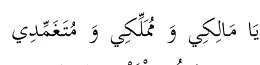
The seat of judgment (dakkat al-qaza’) was a shop-like structure inside Masjid al-Kufah in which there was a bench that was used by Imam ‘Ali (‘a) for judging. Next to this place, there was a short column on which the following holy verse was written:

The place of the washtub (bayt al-tast) is the place where one of the miracles of Imam ‘Ali (‘a) was shown:
While an unmarried girl was swimming in a pool, a leech could penetrate into her body to settle in her womb. This leech fed on the blood of that girl and thus grew up. Hence, the girl’s belly began to grow bigger and bigger that her brothers though that she was illegally pregnant. As they intended to kill their sister, they first provided the case before Imam ‘Ali (‘a) to decide about her. The Imam (‘a) ordered that a thick curtain should be erected in one of the sides of the mosque (Masjid al-Kufah) behind which the girl would sit. The Imam (‘a) then asked a famous midwife in al-Kufah city to check the girl. The answer of the midwife came as follows: “O Amir al-Mu’minin, this girl is pregnant. She carries a fetus in her womb.”
However, the Imam (‘a) ordered them to bring a washtub made of clay and he asked them to make that girl sit there. When the leech felt the stench of the clay, it sneaked out from where it had entered and it fell in the washtub. Thus, the innocence of the girl was proved.
According to other narrations, Imam ‘Ali (‘a) extended his hand and brought a piece of ice from the mountains of Syria and put it in the washtub, causing the leech to come out.
ORDER OF DEVOTIONAL ACTS IN MASJID AL-KUFAH
Be it known to you that the order of doing the recommended acts in Masjid al-Kufah according to the opinion of the majority of scholars is that the acts to be done in the center of the mosque come directly after the acts at the fourth column. Hence, the acts of the seat of judgment and the place of washtub should be the last of all, which means that they are done after the accomplishment of the acts at the seat of Imam al-Sadiq (‘a) (dakkat al-sadiq).
In this book, I imitate the order followed by Sayyid Ibn Tawus, in his book of Misbah al-Za’ir, ‘Allamah al-Majlisi, in his book of Bihar al-Anwar, and Shaykh Khazir, in his book of al-Mazar.
In conclusion, one who desires to follow the opinion of the majority of scholars may do the acts at the seat of judgment (dakkat al-qaza’) and the place of washtub (bayt al-tast) after accomplishing all the other acts of Masjid al-Kufah.
Back to the acts of dakkat al-qaza’ and bayt al-tast, after finishing from the fourth column, you may walk to dakkat al-qaza’ and offer there a two-unit prayer, reciting in each unit Surah al-Fatihah and any other Surah you like to recite. After accomplishment, you may say the famous Tasbih al-Zahra’ litany and then say the following supplicatory words:
]

[
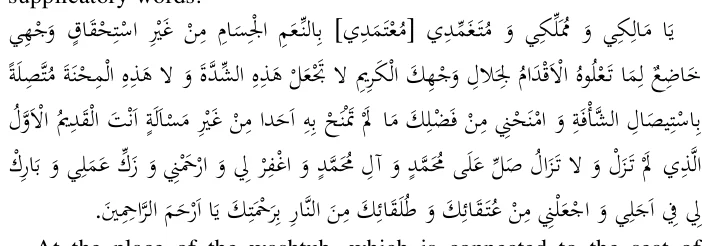
.
At the place of the washtub, which is connected to the seat of judgment, you may offer a two-unit prayer. When you finish the prayer and say the Tasbih statements, you may say the following supplicatory words:
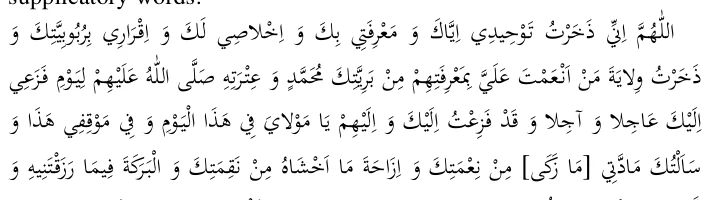
]

[

.
It is narrated that Imam al-Sadiq (‘a) offered a two-unit prayer in this place; the place of the washtub (bayt al-tast).