DUAS AT DAYBREAK AND SUNSET
Be it known to you - may Allah grant you His support - that the traditions about the merits of doing acts of worship at the two hours of daybreak and sunset are too many to be counted. Likewise, too many are the litanies and supplicatory prayers that have been reported from the Holy Prophet (s.a.w.a.) and his Household (a.s.) to be said at these two times. However, I will mention in this brief book a few of them, seeking blessings of Almighty Allah.
First: Ibn Baabwayh has reported through a valid chain of authority that Imam AliAmeer al-Momineen(a.s.) said, “He who recites Surah al-Tawheed, Surah al-Qadr, and Ayah al-Kursi before sunrise eleven times, his property will be protected against any feared matter.”
He (a.s.) is also reported to have said, “Whoever recites Surah al- Tawheed and Surah al-Qadr before sunrise, will be saved from sinning on that day even Satan exerts all efforts to make him commit a sin.”
Second: Al-Kulayni, Ibn Baabwayh, Shaykh al-Tusi, and other scholars have reported through valid chains of authority that Imam al- Sadiq(a.s.) said: It is obligatory upon every Muslim to say the following litany ten times before sunrise and before sunset every day:

According to some narrations, the following statement is added to this litany:
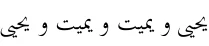
The following statement was mentioned in some narrations and missed in others:
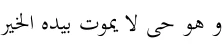
Apparently, whatever form is said is acceptable although it is more acceptable to say the most comprehensive form.
Confirming the significance of this litany, some narrations hold that if you miss saying this litany at these times, you may make up for it later on, because, on the word of other narrations, it remits from sins.
Third: Ibn Baabwayh and other scholars have reported through many chain of authority that Imam Ali ibn al-Husayn and Imam al- Sadiq(a.s.) said, “He who repeats the Takbir statement (i.e. Allahu- akbar) one hundred times at sunset will be given the reward of one who has manumitted one hundred slaves.”
According to another authentic narration, Imam al-Baqir (a.s.) is reported to have said: He who repeats the Takbir statement one hundred times before sunrise and one hundred times before sunset, Almighty Allah will record for him the reward of one who has manumitted one hundred slaves; and he who repeats the following
doxology ten times, will be granted by Allah ten rewards. If he repeats it more, he will be granted more rewards:
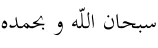
Fourth: Through a valid chain of authority, Ibn Baabwayh reports Imam al-Sadiq(a.s.) to have quoted the Holy Prophet (s.a.w.a.) as saying: In Paradise, there are chambers whose inside can be seen from their outside and whose outside can be seen from their inside. These chambers are dwelled by some of my people who speak good wording, serve food (generously), exchange greetings, and pray at night when the others are asleep. To speak good wording means to repeat the following doxology ten times every morning and evening:

In the book of al-Mahasin, al-Barqi has reported through an authentic chain of authority that Imam al-Baqir (a.s.) related the following:
One day, the Holy Prophet (s.a.w.a.) passed by a man who was sowing a plant in his orchard. The Holy Prophet (s.a.w.a.) stopped and said to him, “May I lead you to a thing that is firmer in sowing, quicker in yielding, and sweeter in fruit?”
“Yes,” the man answered, “You may, Allah’s Messenger.”
The Holy Prophet (s.a.w.a.) instructed:
“In every morning and evening, you may say the following:

If you do, for each statement you will be given trees in Paradise from various kinds of fruits. These statements are the ever-abiding, good deeds about which Almighty Allah has said in His Book that they are best and more enduring than the wealth of this world.”
Fifth: Ibn Baabwayh has reported though a valid chain of authority that Imam Ali(a.s.) said:
Whoever repeats these verses three times before or after evening, will not miss any good item on that day, and will be saved from all evils. The same reward will be for one who repeats them in the morning:

Sixth: In the book of al-Mahasin, al-Barqi has reported through an authenticated chain of authority that Imam al-Rida(a.s.) said: Whoever repeats the following litany three times in the morning and in the evening must not fear any devil, despotic ruler, leprosy, or mycobacterium. As for me, I repeat it one hundred times:

The same litany has been previously cited to be repeated seven times after the Dawn and the Evening Prayers.
Seventh: Through a valid chain of authority, Imam al-Sadiq(a.s.) is reported to have related that the Holy Prophet (s.a.w.a.) had missed one of Ansar (people of al-Madinah who gave shelter and supported the Holy Prophet and the earlier Muslims). When the Holy Prophet (s.a.w.a.) met him afterwards, he asked, “What kept you away from us?”
The man answered, “It was poverty and long disease, Allah’s Messenger.”
The Holy Prophet (s.a.w.a.) said, “May I teach you some words that remove poverty and disease away from you?”
“Yes,” the man answered, “You may, Allah’s Messenger.”
The Holy Prophet (s.a.w.a.) thus said: In mornings and evenings, you may say:

.
Eighth: In many validly reported traditions, Imam al-Sadiq(a.s.) is reported to have said: Repeat the following guard-seeking prayer ten times before sunrise and before sunset:

According to some narrations, the third statement is reported in this form:
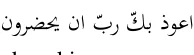
Other narrations have reported this guard-seeking prayer as follows:

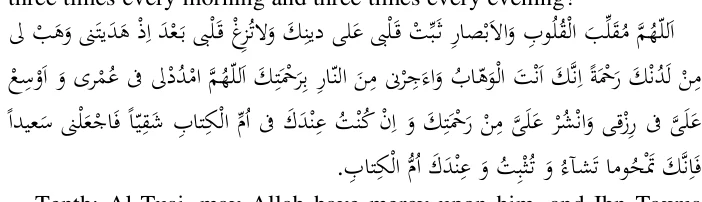
Ninth: In the book of Falah al-Sa’il, Imam al-Sadiq(a.s.) is reported to have said:
What prevents you from saying the following supplicatory prayer three times every morning and three times every evening?
.
Tenth: Al-Tusi, may Allah have mercy upon him, and Ibn Tawus report the Holy Prophet (s.a.w.a.) as saying: Whoever says this word
of glorification one time in the morning and one time in the evening, Almighty Allah sends an angel to Paradise with a silver shovel. The angel then gathers some clay of Paradise, which is sweet smelling musk, fixes a plant, surrounds it with a fence, places a door on it, and writes on the door that this plant is for so-and-so (i.e. writes the name of that person on the door):

In another validly reported tradition, Sayyid Ibn Tawus reports Imam al-Sadiq(a.s.) to have said that whoever says the aforesaid doxology intending to glorify Almighty Allah but not to express amazement, Almighty Allah will erase one thousand of his sins, record for him one thousand rewards, decide for him one thousand rights of intercession, raise him one thousand ranks, and creates from these words a white bird uttering these words of glorification continuously up to the Resurrection day and the reward of the bird’s glorification words will be recorded for that person.
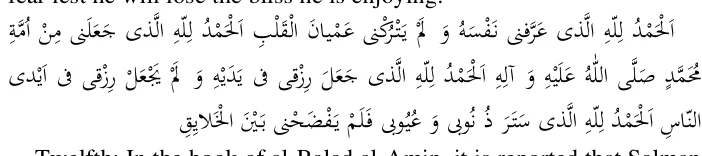
Eleventh: Al-Qutb al-Rawandi has reported that Imam AliAmeer al-Momineen(a.s.) quoted the Holy Prophet (s.a.w.a.) as saying: He who begins his day without mentioning the following four graces, I fear lest he will lose the bliss he is enjoying:
Twelfth: In the book of al-Balad al-Amin, it is reported that Salman the Persian, may Allah be pleased with him, said:
Any servant who repeats the following doxology three times in the morning, Almighty Allah will most surely fend off seventy kinds of afflictions, the easiest of which is distress, from him:

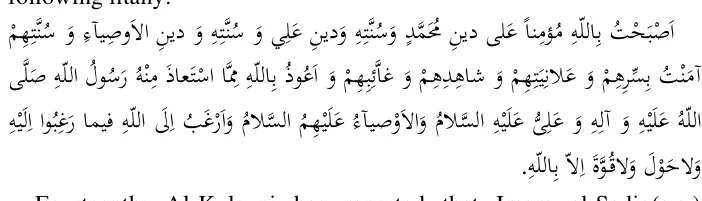
Thirteenth: Through a valid chain of authority, al-Kulayni reports Imam al-Baqir (a.s.) to have said: In the morning, you may say the following litany:
.
Fourteenth: Al-Kulayni has reported that Imam al-Sadiq(a.s.) mentioned many merits for saying the following doxology in the first hour of morning before sunrise:

Fifteenth: In the book of al-Balad al-Amin, Imam al-Sadiq(a.s.) is reported to have said: No tribulation will afflict one who repeats this litany three times in the morning until evening, and no tribulation will afflict him who repeats it three times in the evening until the next morning:

Sixteenth: Al-Kulayni, Ibn Baabwayh, and other scholars have reported through authenticated and valid chains of authority that Imam al-Baqir (a.s.) says: Prophet Noah (a.s.) was described as most grateful servant (indication of Qur’an, 17:3), because he used to say the following doxology every morning and evening:

.
According to other narrations, Prophet Noah (a.s.) used to repeat the following doxology ten times every morning and evening:

However, to say any of the two doxological formulas is good.