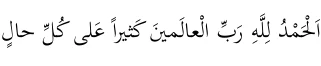
LETTER OF YUSHA THE SON OF NUN
Through a valid chain of authority, Imam al-Rida(a.s.) is reported to have related the following story:
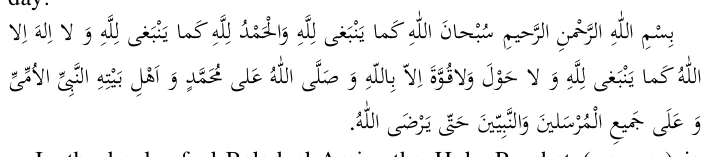
A man found a sheet of paper with an inscription and brought it to the Holy Prophet (s.a.w.a.) who, once he read it, called out at people to gather for a congregational prayer. As everybody came, the Holy Prophet (s.a.w.a.) ascended the minbar (i.e. a pulpit in the mosque) and said: This is the scripture of Yusha’, the son of Nun (Prophet Joshua), the successor of Prophet Moses (a.s.). The inscription reads the following: In the Name of Allah; the All-beneficent, the All- merciful. Your Lord is certainly Kind and Merciful. The best of Allah’s servants are the pious, pure, and affectionate; while the most wicked of Allah’s servants are so identified that fingers can point at them. He who wishes to have his deeds measured by the fairest balance and to carry out his duties towards the graces that Almighty Allah has bestowed upon him, must say the following litany every day:
.
In the book of al-Balad al-Amin, the Holy Prophet (s.a.w.a.) is quoted to have said: He who repeats the following statement ten times every day, will be released from his sins as if he is on the day when his mother gave birth to him, and Almighty Allah will fend off from him
seventy
categories
of
tribulation,
including
lunacy, mycobacterium, leprosy, and paralysis, and Almighty Allah will appoint seventy angels to pray Him to forgive that person:

Imam al-Sadiq(a.s.) is reported to have said: He who repeats the following litany one hundred times every day, will not be afflicted by poverty:
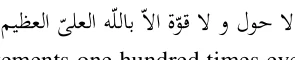
Whoever repeats the following statements one hundred times every day, Almighty Allah will prohibit Hellfire to consume his body:


)
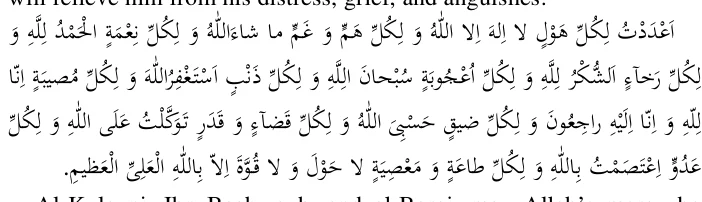
In the book of al-Balad al-Amin, the Holy Prophet (s.a.w.a.) is reported to have said: He who says these words ten times every day, Almighty Allah will forgive four thousand of his grand sins, will save him from the death agonies, the grave pressure, and one hundred of the horrors on the Resurrection Day, will also save him from the evil of Iblis (i.e. Satan) and his troops, will help him settle his debts, and will relieve him from his distress, grief, and anguishes:
Al-Kulayni, Ibn Baabwayh, and al-Barqi, may Allah’s mercy be upon them, have reported through valid chains of authority that Imam al-Sadiq(a.s.) said: He who repeats the following statement ten times every day, Almighty Allah will record for him forty-five thousand rewards, erase forty-five thousand of his sins, raise him forty-five thousand ranks towards Paradise, his saying will be shelter against Satan and despotic rulers, and no grand sin will surround him.
According to another narration, …he will be granted the reward of one who has recited the entire Qur’an twelve times and Almighty Allah will build a house in Paradise for him.
In the narration of Ibn Baabwayh, it is not mentioned that the statement must be repeated ten times:

In the book of Thawab al-A’mal, al-Mahasin, and al-Kafi, Imam al- Sadiq(a.s.) is reported to have quoted the Holy Prophet (s.a.w.a.) as saying: He who repeats the following saying fifteen times every day, Almighty Allah will receive him with His Face and will not turn His Face away from him before he enters Paradise:

In the book of al-Mahasin, the following is reported from the Holy Prophet (s.a.w.a.):
To glorify Almighty Allah one hundred times every day is better than offering one hundred camels as presents to the Holy House of Allah:

To praise Almighty Allah one hundred times every day is better than manumitting one hundred slaves:

To profess Almighty Allah being the Greatest (i.e. too great to be described) one hundred times every day is better than offering hundred horses, along with their saddles and reins, in the way of Allah (i.e. in holy wars):

To profess Almighty Allah being the one and only god one hundred times every day is better than the deeds of all peoples, except those who repeat it more than one hundred times:

Al-Qutb al-Rawandi has related the following story:
A worshipper from the children of Israel (i.e. Israelites) asked Allah the Almighty and Majestic, saying, “O Lord! What is my status with You? If it is praiseworthy, then I will try to add up to my good deeds; but if it is blameworthy, I will repent to You before I die.”
Replying to his question, Almighty Allah sent to him one of His angels to tell him that he has no good point with Allah.
“O Lord!” asked the man, “Where are then all my deeds?”
The Lord answered, “Whenever you did a good deed, you told people about it so that they would consider you virtuous and mention you reputably. Therefore, no reward will be given for your deeds except the reward that you have accepted for yourself.”
This fact disturbed and aggrieved the man extremely; therefore, Almighty Allah sent the same angel to convey the following message to him: “Allah, the Blessed and Exalted, says to you that you must purchase yourself from Him with alms that you must give every day for each one of your veins.”
The man asked, “O Lord! Is there any creature able to do that?”
The Almighty instructed, “You may repeat the following statement three hundred and sixty times, the number of your veins, every day:

The man said, “O Lord! Please, give me more.”
The Almighty said, “If you add to the number, I will add to you.”
Al-Kulayni has reported through a valid chain of authority that Imam al-Sadiq(a.s.) said: The Holy Prophet (s.a.w.a.) used to repeat the following doxology three hundred and sixty times, the number of the veins, each day: