NIGHT & DAY OF 25TH ZILQAD (THE SPREADING OF THE
EARTH)
THE TWENTY-FIFTH NIGHT OF ZILQAD;
The Earth Spreading night
This night is called laylat dahw al-ard (the night at which the earth was spread on the water where the Holy Ka’bah is now situated). Being distinctively honorable, at this night the mercy of Almighty Allah is poured on people. A great reward is obtained by those who practice acts of worship at this night. Ali ibn al-Hasan al-Washsha’ has narrated that when he was young, he was with his father in the hospitality of Imam al-Rida(a.s.) at the twenty-fifth night of Dhu’l- Qa’dah. After they had their supper, Imam al-Rida(a.s.) said, “At the twenty-fifth night of Dhu’l-Qa’dah, Prophet Abraham was born, Prophet Jesus the son of Mary was born, and the earth was spread on the water where the Holy Ka’bah is now situated. Hence, if one observes fasting on this day, he will be given the reward of observing fasting in sixth months.” According to another narration, Imam al- Rida(a.s.) added, “Verily, on this day, al-Qa’im (i.e. Imam al-Mahdi) will appear.”
THE TWENTY-FIFTH OF ZILQAD;
The Earth Spreading Day
The twenty-fifth of Dhu’l-Qa’dah is one of the four days on which fasting is exclusively confirmed. According to a narration, to observe fasting on this day is equal to seventy year fasting. It also erases the sins of seventy years. According to another narration, to observe fasting on this day and to practice acts of worship at its night is equal (in reward) to one hundred year worship. Everything that is between the sky and the earth will ask God’s forgiveness for one who does these rites. On this day, the mercy of Almighty Allah has been spread. To practice acts of worship and hold sessions for mentioning Almighty Allah on this day bring about an abundant reward. Apart from fasting, acts of worship, remembrance of Almighty Allah, and bathing, there are two other acts that are advisably done on this day:
First: The books written by Shi’ite scholars of Qumm have mentioned that, on this day, it is recommended to offer, in the morning, a prayer consisting of two units, reciting in the each unit Surah al-Faatehah once and repeating Surah al-Shams (No. 91) five times. After accomplishment, the following litany is said:
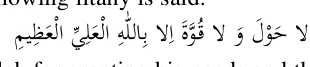
Then, one may pray Almighty Allah for granting his needs and then say the following supplicatory prayer:

.
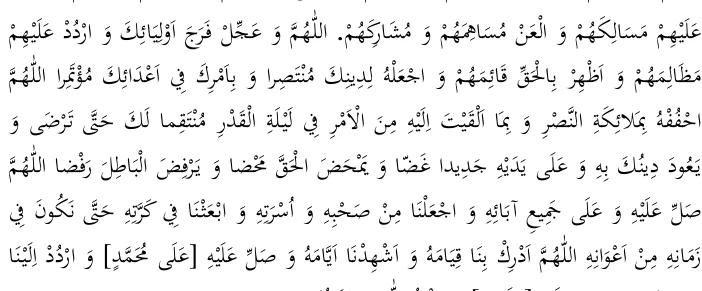
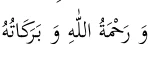
Second: In Misbah al-Mutahajjid, Shaykh al-Tusi has mentioned that it is recommended to say the following supplicatory prayer on this day:
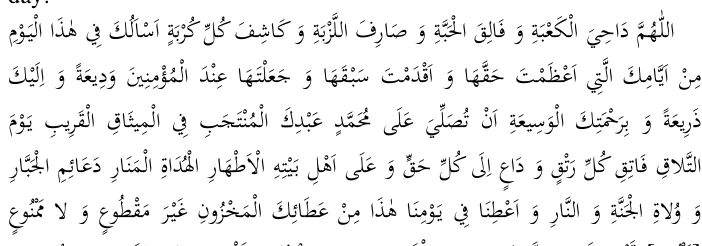
]
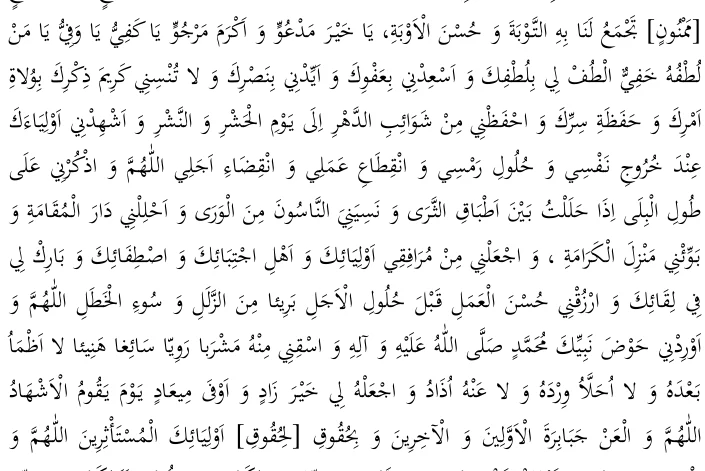
]

[
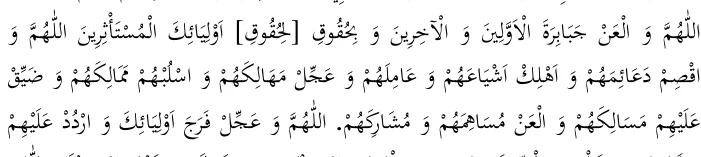
.
]

[

]

[
.
In his epistle entitled al-Arba’at Ayyam (The Four Days), Sayyid al-Damad has mentioned that to visit the holy tomb of Imam Ali ibn Musa al-Rida(a.s.) on the day; i.e. the Earth Spreading Day, is the most preferable act. Similarly, to visit his tomb on the first of Rajab is highly desirable; therefore, he has urged on it greatly.
THE LAST DAY OF ZILQAD
On the last day of Dhu’l-Qa’dah 220 AH, Imam Muhammad ibn Ali al-Yaqi al-Jawad(a.s.) was martyred. He was poisoned by Al- Mu’tasim Bi’llah, the ‘Abbasid ruler. That was only two years and a half after the death of al-Ma’mun, the ‘Abbasid ruler. The Imam (a.s.) himself had predicted so when he said, “Relief shall come thirty months after the death of al-Ma’mun.”
In fact, this statement reveals the scope of torture and pain that were suffered by the Imam (a.s.) in his life with al-Ma’mun. Hence, the Imam (a.s.) regarded his passing away as relief. Similarly, his father, Imam Ali ibn Musa al-Rida(a.s.), suffered the same pains and hardships when he was appointed as the crown prince. Whenever he returned from the mosque on Fridays, Imam al-Rida(a.s.) used to raise his hands to the sky, sweaty and dust-covered, and supplicate to Almighty Allah, saying, “My God, if my death is my relief, then please do hasten the hour of my death.” He, furthermore, was always depressed and miserable until he departed life.
Imam Muhammad ibn Ali al-Yaqi(a.s.) lived for twenty-five years and a few months only. His holy tomb is directly behind the holy tomb of his grandfather, Imam Musa al-Kazim (a.s.), in the city of al- Kazimiyyah, Baghdad.