SUPPLICATORY PRAYER FOR SEEKING REFUGE WITH
ALLAH
DU’A’ AL-I’TISAM
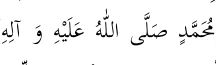
Seventh Tradition: According to a validly reported tradition, when Imam al-Sadiq (‘a) came to Iraq, some people came to him and asked, “We have already known that the clay of Imam al-Husayn’s tomb is remedy for all maladies. Is it also security against all feared matters?”
The Imam (‘a) answered, “Yes, it is. Whoever would like this clay to secure him against all fears, may hold a rosary made of that clay in his hand and repeat the following supplicatory prayer three times:

]

[

]

[

]
[

]

[
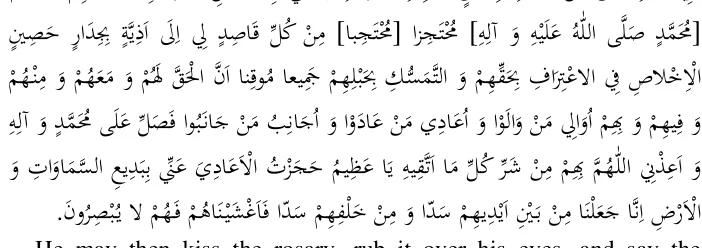
.
He may then kiss the rosary, rub it over his eyes, and say the following supplicatory words:
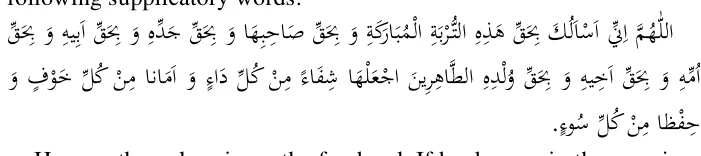
.
He may then place in on the forehead. If he does so in the morning, he will be under the security of Almighty Allah up to the evening; and if he does so in the evening, he will be under the security of Almighty Allah up to the next morning.”
According to another tradition, it has been reported that one who fears the persecutive power of a ruler or any other tyrannical person, may do the same as the aforementioned instructions when he goes out of his house so that this will be protection for him.
As a familiar ruling decided by master scholars of Muslim jurisprudence, it is impermissible to have any thing of dust or clay except the blessed clay taken from Imam al-Husayn’s tomb in purpose of seeking healing and with no intention to have an agreeable taste from it provided that the amount that may be had must be as small as a chick-pea grain or, as a precautionary ruling, is not bigger than a seed
of lentil. It is also preferred to put that amount of clay in the mouth and have a drink of water, saying the following supplicatory words:

.
‘Allamah al-Majlisi says that it is precautious to avoid selling the rosary of prostration-clay that are made of the clay of Imam al- Husayn’s tomb; rather, such things must be given as gifts. However, it may be unobjectionable that the two parties of such transaction (of selling or purchasing objects made of this clay) reach an agreement consensually without specifying any article as condition in advance. Supporting this ruling, Imam al-Sadiq (‘a), in a validly reported tradition, is reported to have said, “Whoever sells the dust of Imam al- Husayn’s tomb is considered as having sold his own flesh.”
Our well-versed traditionist and mentor, Shaykh al-Nuri, has mentioned the following story in his book of Dar al-Salam:
When one of my brothers presented himself before my mother, may Allah rest her soul, she noticed that he had put a piece of the clay of Imam al-Husayn’s tomb in his pocket, which is under his garment. She thus reproached him, saying, “This is impoliteness! This piece of clay may be under your thigh and then broken.” He answered, “This is true! Two pieces of this clay have been already broken.” He then promised her not to do this ever again.
A few days later, my father the master scholar, may Allah raise his rank, who did not know about this incident, saw in sleep that our master Imam al-Husayn, peace be upon him, visited him and sat in the reading room where my father used to sit. The Imam (‘a) treated him with kindness and then asked him to summon his sons so that the Imam (‘a) would honor them. So, my father sent for them, who were five with me, and they stood next to the door before the Imam (‘a), who had some stuff of dresses and other things in his hand. He thus called them one by one and gave them a part of that stuff. When it was the turn of my brother whom had been reproached by my mother, the Imam (‘a) looked at him with some anger, turned his face towards my father, and said, “This son of you has broken two pieces of clay taken from my tomb under his thigh.” Then, the Imam (‘a) threw something towards my brother without asking him to take it. As much as I remember, the Imam (‘a) gave my brother a comb-like apparatus that is usually made of clothing and [used in engraving on carpets] called in Persian tirmeh. Hence, when my father woke up, he told my mother of this dream and she told him of her story with her son. So, my father was amazed of this incident.